
Harvard Defenders provides free representation to low-income community members in criminal clerk-magistrate’s hearings.
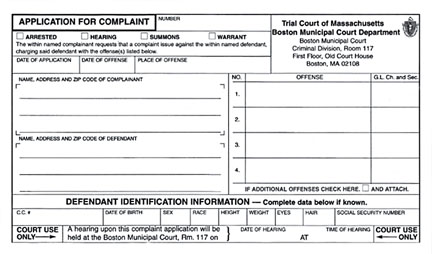
Criminal clerk-magistrate’s hearings (also known as “show-cause” hearings) occur when the police or the alleged victim of a crime file an Application for a Criminal Complaint with the court. After an application has been filed, the court will send the accused a notice in the mail requesting them to appear in a criminal clerk-magistrate’s hearing. At this hearing, the complaining party must produce evidence demonstrating “probable cause” that the accused committed the crime.
The hearing has three possible outcomes: 1) the complaint is dismissed, 2) the complaint is issued, or 3) the complaint is continued.
- If the complaining party fails to show probable cause, the complaint will be dismissed. This means that no charges will be filed against the accused person and neither the case will not appear on the person’s criminal record.
- If probable cause is shown, the clerk-magistrate may decide that the complaint be issued. If the complaint is issued, the person will be arraigned. At arraignment, the person will be formally charged with a crime and may be provided court-appointed counsel if financially eligible. Issuance of the complaint is not a determination of guilt or innocence, but the charges will appear on the person’s criminal record.
- A finding of probable cause does not guarantee the complaint will be issued. Instead, the clerk-magistrate may decide that the complaint be continued. This means the clerk-magistrate will hold the complaint open for a specified period, usually ranging from three months to a year from the hearing date. At the end of the continuance period, the complaint will be dismissed if the person complies with the conditions set by the clerk-magistrate. Nothing will appear on the person’s record if the complaint is dismissed after the continuance period.